
The Unstable Border of Reality
The Wind-Up Bird ChronicleThis thread traces how ordinary perception gives way to competing realities, until Toru Okada must act without being able to prove which world he inhabits.
increasing Bearing strength in each event
 decreasing
Bearing strength in each eventdecreasingThe Missing Cat
An Ordinary Absence
A Domestic Mystery
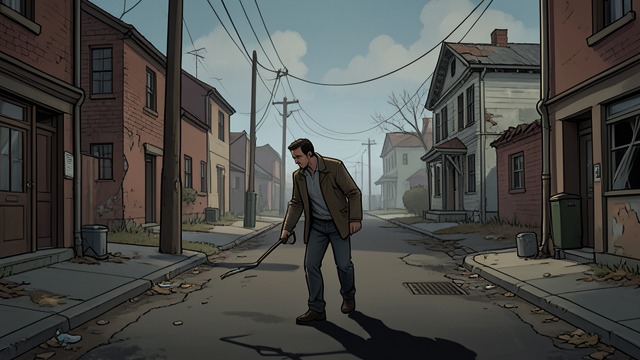
The disappearance of the household cat begins as a practical problem: Toru Okada searches the neighborhood because Kumiko asks him to. Yet the search soon draws him toward the abandoned Miyawaki house, where ordinary spaces feel oddly detached from everyday life.
Uncertain Evidence
Malta Kano tells Toru that the cat has left the neighborhood, while May Kasahara remembers seeing a similar animal. Neither account gives him proof. The gap between what people report and what Toru can verify becomes an early model for the book’s larger uncertainty.
A Stranger in the Telephone
A Voice Without a Face
Intimacy at a Distance
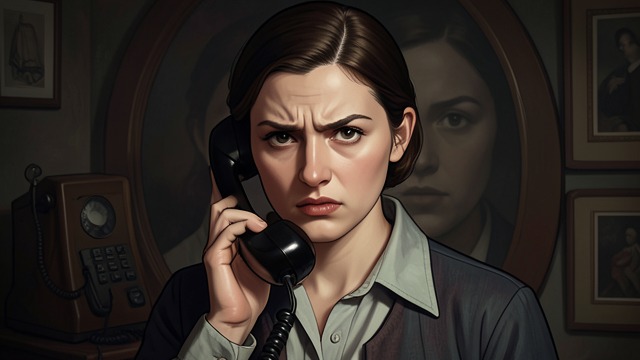
The Telephone Woman speaks to Toru with disconcerting familiarity but offers no identity he can check. Her intimate propositions make the call feel personal, yet its disembodied form denies him the ordinary cues that might establish who is speaking.
Knowledge Without Recognition
She knows details about Toru, including his age, while he cannot recognize her voice. That reversal unsettles his confidence in memory: familiarity may arrive without conscious recollection, and apparent knowledge may remain impossible to interpret.
The Room Beyond the Wall

Passage into Another World
A Door in Darkness
In a waking experience that resists being called either dream or fact, Toru passes through a hotel-room wall with the Telephone Woman. He finds himself back at the bottom of the well, carrying a physical sensation of heat that later becomes a visible mark on his cheek.
The Body as Testimony
The mark supplies material evidence for an event that Toru cannot explain. Yet evidence does not settle the matter: it confirms that something happened to his body without proving how the wall, the room, or the transition worked.
Two Worlds on Television
Public Image and Private Reality
A Political Performance
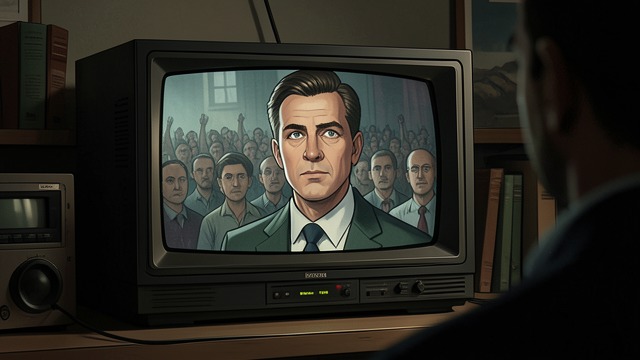
Toru sees Noboru Wataya addressing a crowd through a television screen. The speech seems directed at him personally, although its public form lets every other listener understand it as a general political address.
The Unverifiable Message
Television becomes both a mass medium and a possible channel for private communication. Toru cannot demonstrate that Noboru’s words target him, but their emotional force is real to him. The episode sharpens the novel’s distinction between what can be proven and what can still exert power.
The Newsroom Reflection
The Screen and the Witness
A Report of an Attack
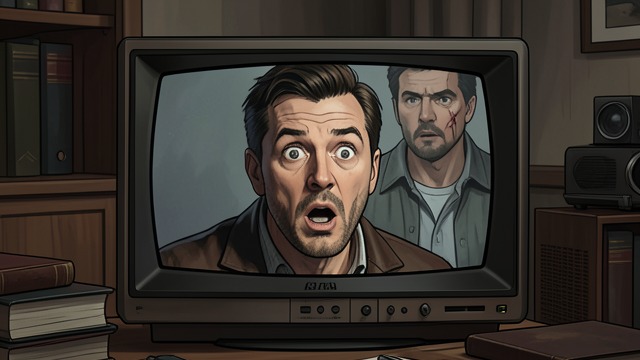
In the hotel-world, Toru watches a news report describing an attack on Noboru Wataya by someone whose clothing, height, and cheek mark resemble his own. He has not consciously made that attack, yet the report describes a figure strikingly like him.
A Divided Self
The discrepancy forces Toru to confront the possibility that an act can belong to one version of a person without belonging to the version that remembers it. The novel leaves the relation between the reported event and Toru’s experience unresolved, making uncertainty itself part of the conflict.
Early June 1984
June 1984, during the first mysterious calls
After Toru becomes trapped in the well
After Toru enters the hotel-world in the well
During Toru’s final journey through Room 208
